

Affection Fades. Unease Endures
What Madame X Knows That Klimt Forgot

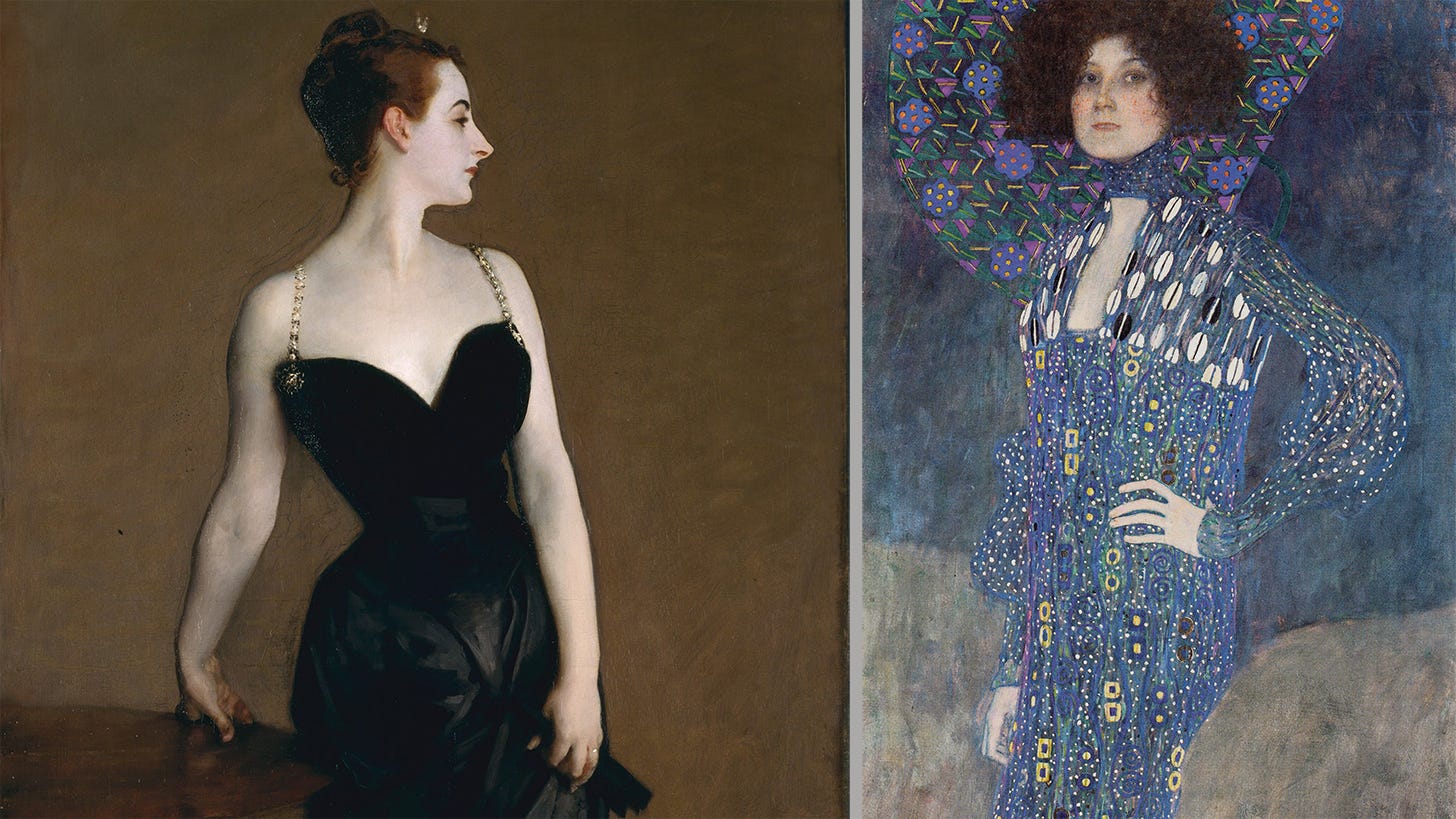
Paris, 1884. A portrait is unveiled at the Salon and the room turns hostile. The subject — Virginie Gautreau, a Louisiana-born socialite who had built her Parisian reputation on calculated beauty — is shown in a black evening gown, one shoulder strap fallen, her profile turned away, chin level, her indifference complete. The painter, John Singer Sargent, intended a masterpiece. What he produced was a scandal. Gautreau retreated from public life, her carefully constructed social prominence destroyed by the image she had agreed to sit for. Sargent fled to London to rebuild his career from scratch.
The painting is now called Madame X (left, detail). It hangs at the Metropolitan Museum of Art in New York and travels to major exhibitions worldwide. It is among the most reproduced portraits of the nineteenth century.
The same era produced Gustav Klimt — a painter so embedded in collective visual memory that people recognize his images without knowing his name. Ask someone who painted The Kiss and they may not know. Show them the image and they know it instantly. The same is true of his Portrait of Adele Bloch-Bauer I, her identity half-dissolved into a gold ground of Byzantine complexity. Klimt was entirely capable of producing images that escape their maker and lodge permanently in cultural memory.
Which makes what happened with Emilie Flöge (right, detail) worth examining carefully.
Flöge was Klimt’s closest companion, his intimate friend of nearly three decades. She and her sisters ran the Schwestern Flöge, a progressive Viennese fashion atelier that designed and sold Reform dress: loose, uncorseted clothing intended to free women’s bodies from the physical constraints of conventional fashion. In 1902 Klimt painted her standing in one of those Reform dresses — patterned, unstructured, her body entirely at ease. The painting is competent. It is in the Wien Museum in Vienna. It is largely unknown outside art history circles.
Consider what these two paintings place side by side. Gautreau’s body is submitted to every instrument of fashionable punishment available in 1884 — the corset compressing her organs, the arsenic-laced cosmetics achieving the prized pallor of her skin, the pose torquing her spine into a position that would eventually exact a physical cost. Flöge’s body refuses all of that. She stands free, in clothing she helped design, in the company of a man who knew and respected her.
The liberating painting disappeared. The punishing one travels the world.
This is not a contrast between a forgotten painter and a celebrated one. Klimt produced images of permanent cultural force. The variable is not talent. Something else determines which paintings last.
That something is irresolution.
Madame X does not settle. Stand in front of it and you can read it simultaneously as triumph and humiliation, as sexuality and cruelty, as a woman commanding the room and a woman being consumed by the room’s judgment. The fallen shoulder strap — which Sargent later painted back into place under social pressure, though the original position is what everyone remembers — concentrates all of that ambiguity into a single detail. The painting holds competing readings in permanent suspension. It never concludes.
The Flöge portrait concludes. She stands there, comfortable, understood, at peace. Nothing pulls at the viewer because nothing was pulling at the painter.
Klimt knew Flöge too well to paint her with tension. She was his intimate companion of decades. He understood her project, admired her mind, shared her world. When he stood before her with a canvas he had nothing left to discover. The painting shows exactly that — clear sight, warm feeling, complete understanding — and it is inert because of it.
The tension that makes a portrait live often comes from what the painter cannot resolve about the subject. Sargent did not know Gautreau. He knew her reputation, her public performance, her social armor. He painted that armor with full virtuosity — and simultaneously, perhaps without fully intending to, painted the body straining inside it. The gap between those two things is where the painting’s energy lives and has never stopped living.
Klimt with Flöge had no such gap. His most intimate relationship produced his most forgettable major portrait. The Kiss — painted from desire and ambiguity, from something unresolved — outlasted the portrait of the woman he actually knew. Intimacy, it turns out, may be the enemy of the unforgettable image.
Sargent understood this lesson only partially, and too late. After fleeing Paris he rebuilt his career in London painting aristocrats and wealthy patrons in socially acceptable ways. His virtuosity was intact. His willingness to find the gap between performance and body, between armor and the straining life inside it, was gone. He now knew what his subjects wanted and he delivered it. Those portraits are admired, collected, and forgotten in roughly equal measure. The socially acceptable work did not survive with the same force as the socially unacceptable — because acceptable portraiture, like the Flöge portrait, resolves before it begins.
What then is the lesson? Be ruthless — paint like Lucian Freud, who spent his career being deliberately and systematically unsparing about the body? The twentieth century eventually built a critical framework around his ruthlessness that made it legible as genius. Sargent had no such framework. Portraiture in 1884 was a social contract: the painter flatters, the subject is elevated, both parties benefit. He broke that contract — not out of calculated ruthlessness but out of the ambition to paint something true — and paid for it.
The thing that got away from him was the thing he was proudest of. He held that judgment after the scandal, the flight to London and years of socially safer commissions. He could recognize the painting’s force without being able to account for its source. That may be the most honest thing a painter can admit: that the work knew something the painter did not.
Kindness in painting — to the subject, to the viewer, to one’s own settled feelings about what one is looking at — may be a form of forgetting. The unforgettable image is rarely the intended one. It is the image that could not be fully controlled, that held more than its maker put into it, that keeps generating meaning long after the scandal or the friendship or the sitting has passed into history.
Gautreau died in 1915, largely forgotten. Madame X endures. Flöge lived until 1952, respected in Vienna, her Reform atelier part of the historical record. Her portrait sits quietly in its museum.
“The work knew something the painter did not”
So interesting to hear the stories behind these two paintings. I've long admired both artists, and love Singer's portraits just for their brilliance. The luminosity of X's skin, the depth of the blackness of her gown, the brilliant contrast between the two. And then the tilt of her head turning away from the camera, so to speak, invites a mystery--why? what is she thinking? Then there's just the sensuousness of the whole thing. I love it and think the scandal is not deserved, but typical, even today, of critics who scorn something so different and beautiful, who want to mock what is brilliant. So sad.